07 Aug-26
Best Job oriented Courses in India : Pathway to VISION 2047
Best Job-Oriented Courses in India: Build a Career with the Right Skills
Choosing the right course after 10th, 12th, or graduation can significantly influence your career. In today's competitive job market, a traditional degree alone may not always be enough. Employers increasingly look for candidates who have practical knowledge, industry-specific skills, work experience, and the ability to perform from day one.
This is why job-oriented courses in India are becoming increasingly popular among students, working professionals, and career changers.
Job-oriented courses are designed to provide specialized knowledge and practical skills for specific industries. They can help students enter the workforce faster and can also provide a pathway for higher education and career advancement.
What Are Job-Oriented Courses?
A job-oriented course is an education or training program designed around the skills and competencies required for a particular job or industry.
Unlike purely theoretical programs, these courses generally emphasize:
-
Practical training
-
Industry-relevant skills
-
Hands-on learning
-
Internship or field exposure
-
Technical knowledge
-
Professional certifications
-
Employability skills
-
Career-specific specialization
The objective is simple: learn skills that employers need and become ready for employment.
Why Are Job-Oriented Courses Important in India?
India has a large and diverse workforce, but employers often face difficulty finding candidates with the right practical skills. This has increased the importance of vocational education, skill development, internships, and industry-based learning.
A job-oriented course can offer several advantages:
1. Faster Entry into Employment
Many career-focused courses are shorter than conventional degree programs. Students can acquire specialized skills and start exploring employment opportunities relatively quickly.
2. Practical Knowledge
Students get an opportunity to understand how their classroom learning is applied in real workplaces.
3. Industry-Relevant Skills
Good job-oriented programs are designed around current industry requirements and can help students develop technical and professional competencies.
4. Better Career Focus
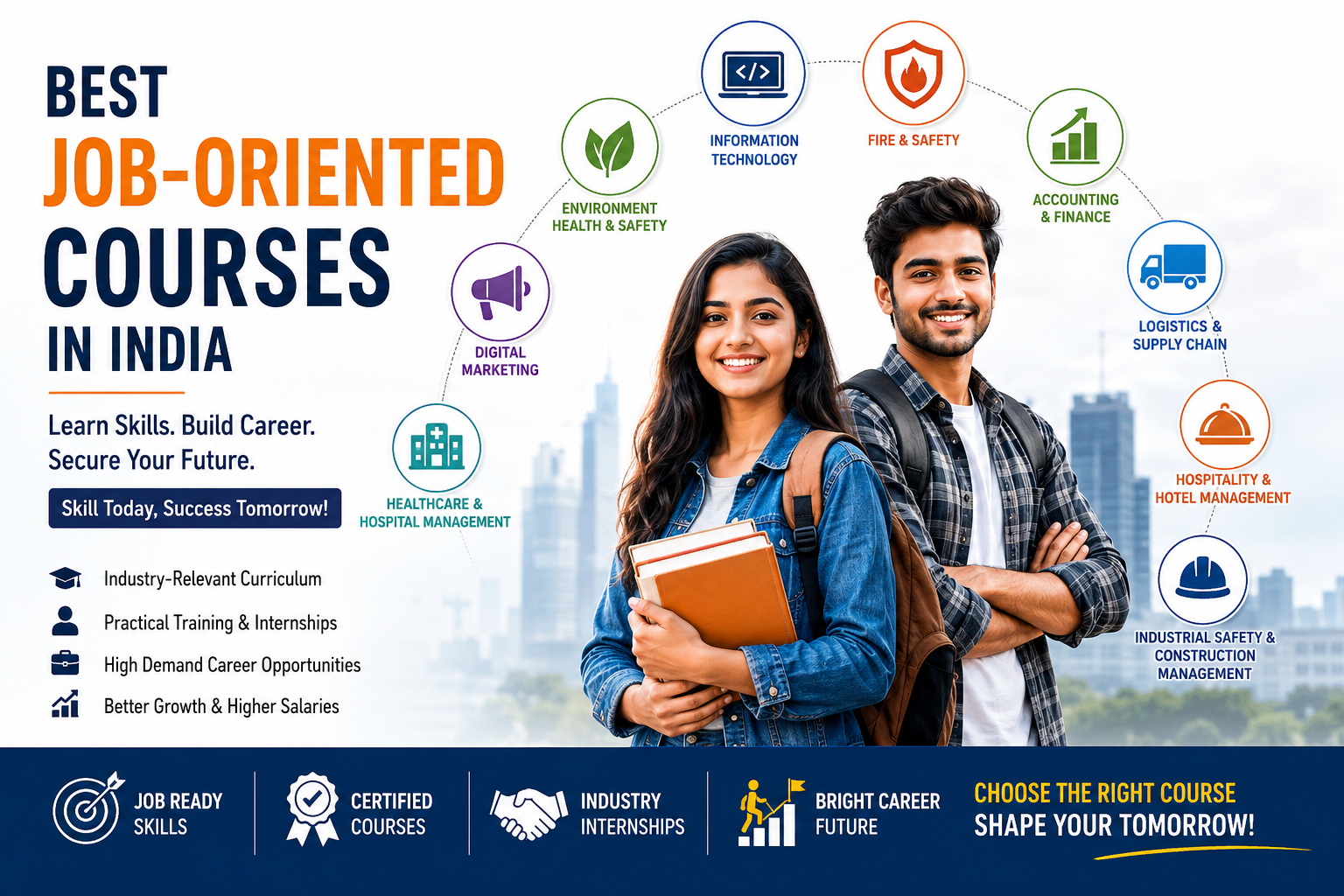
Instead of studying a broad range of subjects, students can focus on a specific career area such as fire safety, healthcare, IT, digital marketing, accounting, or industrial safety.
5. Internship and Field Exposure
Courses that include internships, projects, industrial visits, or practical training can provide valuable exposure to actual working environments.
6. Opportunities for Career Growth
Skill-based education does not necessarily mean stopping education after getting a job. Students can combine vocational qualifications with graduation, postgraduate education, certifications, and professional experience.
Top Job-Oriented Courses in India
The best course depends on your educational qualification, interests, career goals, and the demand for particular skills in the market.
Here are some promising job-oriented fields to consider.
1. Fire & Safety Courses
Fire and industrial safety is an important career field because factories, construction projects, warehouses, hospitals, hotels, infrastructure projects, commercial buildings, and other organizations require safety systems and trained personnel.
Popular programs include:
-
Certificate in Fire Fighting
-
Fireman Course
-
Diploma in Fire & Safety
-
Diploma in Fire Technology & Safety Management
-
Diploma in Industrial Safety
-
PG Diploma in Fire Safety
-
B.Sc. Fire & Safety
-
B.Sc. Environment, Health & Safety
-
M.Sc. Fire & Safety / Environment, Health & Safety
Career Opportunities
Depending on qualification and experience, candidates may explore roles such as:
-
Fire & Safety Officer
-
Safety Officer
-
Fireman
-
Safety Supervisor
-
HSE Executive
-
EHS Officer
-
Industrial Safety Supervisor
-
Fire Safety Trainer
-
Safety Coordinator
Students interested in this sector should look for programs that provide practical fire-fighting training, industrial visits, emergency response training, risk assessment, safety management, and internship opportunities.
2. Environment, Health & Safety (EHS)
EHS has emerged as an important multidisciplinary career area combining environmental management, occupational health, workplace safety, and regulatory compliance.
Organizations across manufacturing, construction, infrastructure, logistics, energy, healthcare, and other sectors require professionals who understand workplace hazards and safety management.
Relevant programs include:
-
Diploma in Environment, Health & Safety
-
PG Diploma in Environment, Health & Safety
-
B.Sc. Environment, Health & Safety
-
M.Sc. Environment, Health & Safety
Potential Career Roles
Graduates and trained professionals may work as:
-
EHS Officer
-
HSE Executive
-
Safety Executive
-
Environmental Safety Executive
-
Safety Supervisor
-
HSE Coordinator
-
Industrial Safety Professional
For students looking for a career combining technical knowledge with safety and environmental management, EHS can be a strong option.
3. Computer Applications and IT Courses
Information technology continues to influence almost every industry.
Students who develop practical digital skills can explore careers in areas such as:
-
Computer applications
-
Web development
-
Software support
-
Data management
-
Digital services
-
IT administration
-
Cybersecurity
-
Artificial intelligence
Job-oriented options may include:
-
Diploma in Computer Applications
-
BCA
-
MCA
-
Web Designing
-
Software Development
-
Data Analytics
-
AI-related courses
-
Cybersecurity courses
Students should prioritize courses that include practical projects rather than relying exclusively on theoretical learning.
4. Digital Marketing
Digital marketing has become an important business function as organizations increasingly depend on websites, search engines, social media, online advertising, and digital commerce.
A practical digital marketing course may cover:
-
Search Engine Optimization (SEO)
-
Social media marketing
-
Google Ads
-
Content marketing
-
Email marketing
-
Website management
-
Analytics
-
Online branding
-
AI tools for marketing
Career Opportunities
Possible roles include:
-
Digital Marketing Executive
-
SEO Executive
-
Social Media Executive
-
Content Marketing Executive
-
PPC Executive
-
Digital Marketing Manager
-
Freelancer
-
Entrepreneur
Digital marketing can be particularly attractive to individuals who want both employment and entrepreneurial opportunities.
5. Healthcare and Hospital Management
India's healthcare sector requires professionals not only in clinical roles but also in administration, operations, quality management, hospital systems, and healthcare services.
Job-oriented programs in healthcare management can prepare students for non-clinical roles.
Possible areas include:
-
Hospital administration
-
Healthcare management
-
Medical operations
-
Healthcare quality management
-
Hospital marketing
-
Patient relationship management
-
Healthcare project management
An MBA or other specialized qualification in Hospital & Healthcare Management can be considered by graduates and working professionals interested in management-oriented healthcare careers.
6. Accounting and Finance Courses
Accounting remains an essential function for businesses of all sizes.
Students interested in finance can develop practical skills in:
-
Accounting
-
GST
-
Tally
-
Payroll
-
Financial documentation
-
Income tax basics
-
Bookkeeping
-
Financial reporting
Possible career options include:
-
Accounts Executive
-
Junior Accountant
-
Finance Assistant
-
Tax Assistant
-
Payroll Executive
-
Billing Executive
Courses that combine accounting theory with software-based practical training can be particularly useful for entry-level employment.
7. Vocational and Skill-Based Courses
Vocational education provides an alternative pathway for students who want practical and employment-focused education.
Depending on the sector, vocational courses can be available in areas such as:
-
Fire & Safety
-
Healthcare
-
IT
-
Electrical
-
Construction
-
Automotive
-
Retail
-
Hospitality
-
Beauty & Wellness
-
Logistics
-
Tourism
The major advantage is that students can develop sector-specific skills instead of following only a conventional academic pathway.
8. Logistics and Supply Chain Management
The growth of e-commerce, manufacturing, warehousing, transportation, and organized retail has increased the importance of logistics and supply chain operations.
Students can explore courses covering:
-
Warehouse management
-
Inventory management
-
Transportation
-
Procurement
-
Supply chain operations
-
Logistics technology
-
Distribution management
Career opportunities may include:
-
Logistics Executive
-
Warehouse Executive
-
Inventory Executive
-
Supply Chain Executive
-
Operations Coordinator
-
Procurement Executive
9. Hospitality and Hotel Management
India's tourism, hospitality, travel, and food-service sectors provide employment opportunities for trained professionals.
Job-oriented courses may cover:
-
Food production
-
Food and beverage service
-
Front office operations
-
Housekeeping
-
Hotel operations
-
Event management
-
Hospitality management
Career opportunities can include employment in hotels, resorts, restaurants, airlines, tourism companies, event organizations, and other hospitality businesses.
10. Construction and Infrastructure Safety
India's infrastructure development has created demand for professionals who understand construction operations and workplace safety.
Students can consider specialized programs in:
-
Construction safety
-
Industrial safety
-
Occupational safety
-
Fire prevention
-
Risk management
-
Health and safety management
These programs can be especially relevant for students who want to work on construction sites, infrastructure projects, industrial facilities, and large-scale development projects.
Job-Oriented Courses After 10th
Students who have completed Class 10 can consider skill-focused certificate and vocational programs.
Examples include:
-
Basic Fire Fighting
-
Fireman training
-
Computer applications
-
Electrician-related vocational programs
-
Automotive courses
-
Hospitality skills
-
Retail and sales
-
Healthcare support services
-
Skill development programs
The right choice depends on the student's interest and long-term career objective.
Job-Oriented Courses After 12th
After Class 12, students have a much wider range of options.
Some popular areas include:
-
B.Sc. Fire & Safety
-
B.Sc. Environment, Health & Safety
-
BCA
-
BBA
-
Nursing and allied healthcare programs
-
Digital marketing
-
Computer applications
-
Hotel management
-
Logistics and supply chain
-
Vocational degree programs
-
Professional certifications
Students should compare eligibility, duration, curriculum, practical training, recognition, internship opportunities, and career pathways before selecting a program.
Job-Oriented Courses After Graduation
Graduates can specialize in a particular industry through postgraduate programs, diplomas, certifications, or professional courses.
Popular areas include:
-
MBA
-
MBA Hospital & Healthcare Management
-
PG Diploma in Fire Safety
-
PG Diploma in Industrial Safety
-
PG Diploma in EHS
-
Digital Marketing
-
Data Analytics
-
Cybersecurity
-
Project Management
-
Supply Chain Management
-
Human Resource Management
Specialization can help graduates move from general employment toward more focused career opportunities.
How to Choose the Best Job-Oriented Course?
There is no single course that is "best" for everyone.
Before enrolling, consider these important factors:
1. Your Interest
Choose a field that matches your interests and abilities. A high-demand course will not be useful if you have no interest in the profession.
2. Industry Demand
Research whether organizations are actually hiring professionals with the skills taught by the course.
3. Practical Training
Give preference to programs that include:
-
Laboratory work
-
Field training
-
Projects
-
Industrial visits
-
Internships
-
Simulations
-
Practical assessments
4. Recognition and Credibility
Always verify the recognition and approval status applicable to the particular qualification and institution before admission.
5. Faculty and Infrastructure
Experienced faculty, laboratories, training equipment, workshops, and industry exposure can significantly improve the learning experience.
6. Internship Opportunities
An internship can help students understand workplace expectations and gain practical exposure before completing their studies.
7. Career Progression
Don't only ask, "Will this course get me a job?"
Also ask:
"Where can this qualification take me after 5 or 10 years?"
A good career-oriented program should provide opportunities for further education, specialization, certifications, promotions, and professional growth.
Job-Oriented Course vs Traditional Degree
A traditional degree provides broad academic knowledge, while a job-oriented program generally focuses more strongly on specific skills and occupational competencies.
The two approaches do not necessarily have to compete with each other.
A strong career strategy can combine:
Degree + Skill + Practical Training + Internship + Professional Certification
For example, a student may pursue a bachelor's degree while developing additional skills in digital marketing, data analytics, fire safety, EHS, accounting, or another specialized field.
The Future of Job-Oriented Education in India
The future of education is increasingly moving toward a combination of academic knowledge and practical skills.
Technology is changing the nature of jobs, while employers are looking for candidates who can adapt to new tools, processes, and workplace requirements.
Artificial intelligence, automation, digital transformation, green technologies, healthcare expansion, infrastructure development, logistics, and industrial growth are creating new skill requirements.
Therefore, students should not think of education as something that ends with a certificate or degree.
Continuous learning is becoming an important part of career development.
Final Thoughts
Choosing the best job-oriented course in India requires more than simply looking at a list of popular courses.
The right course should match three important factors:
Your Interest + Industry Demand + Practical Skills
Whether you choose Fire & Safety, Environment Health & Safety, IT, Digital Marketing, Healthcare Management, Accounting, Logistics, Hospitality, or another vocational field, focus on acquiring skills that can be demonstrated in a real workplace.
Before taking admission, compare the institution, curriculum, recognition, practical training, internship structure, faculty, infrastructure, fee, and career progression opportunities.
The goal should not simply be to earn a certificate.
The goal should be to become employable, skilled, and prepared for long-term career growth.
Frequently Asked Questions
Q1. Which is the best job-oriented course in India?
There is no single best course for everyone. Fire & Safety, EHS, IT, healthcare management, digital marketing, accounting, logistics, and other specialized fields can offer different career pathways.
Q2. Which job-oriented courses can be done after 12th?
Students can explore B.Sc. Fire & Safety, B.Sc. EHS, BCA, BBA, vocational programs, digital marketing, computer applications, hospitality, logistics, healthcare, and other career-focused courses depending on eligibility.
Q3. Are job-oriented courses better than traditional degrees?
They serve different purposes. A combination of an academic qualification and practical, industry-relevant skills can often provide a stronger career foundation.
Q4. Is internship important in a job-oriented course?
Yes. Internship and practical exposure can help students understand workplace processes and develop practical skills.
Q5. What should I check before joining a job-oriented course?
Check eligibility, duration, curriculum, recognition/approval status, practical training, internship opportunities, faculty, infrastructure, assessment system, fees, and potential career pathways.
Q6. Can job-oriented courses help students become entrepreneurs?
Yes. Certain fields such as digital marketing, computer applications, accounting, technical services, and specialized vocational skills can also provide opportunities for freelancing, consulting, or entrepreneurship.